Sleep like a pro: the complete guide to mastering sleep for competitive edge
13 February 2026|Written by: Dream Chronicler
You already track your HRV. You monitor your resting heart rate. You log every session, dial in your nutrition, and push hard six days a week. But if your sleep is sitting at six hours a night, you are leaving serious performance gains on the table.
Sleep is not just recovery. It is the phase where your body actually rebuilds muscle fibres, consolidates motor skills, regulates stress hormones, and sharpens the neural pathways that make you faster, stronger, and sharper under pressure. No supplement stack, no recovery boot, and no ice bath comes close to the ROI that quality sleep delivers night after night.
This guide breaks down exactly what sleep does to your performance, what the science says about how much you actually need, and the practical habits that competitive athletes and high performers use to protect and optimise every hour in bed. Whether you are chasing a sub-four marathon, a new clean and jerk PR, or simply trying to show up to Monday training without dragging yourself through the door, this is the guide you need.
Why sleep is your highest ROI recovery tool
Every training session creates microscopic damage. Sleep is when the repair work happens.
During deep sleep (also called slow wave sleep), your pituitary gland releases the majority of your daily growth hormone pulse. That hormone drives muscle protein synthesis, accelerates tissue repair, and restores connective tissue stressed by heavy load or high volume. Without enough deep sleep, that repair cycle is cut short, and you return to training in a partially recovered state.
There is also a cognitive dimension. REM sleep, the lighter, dream active stage that dominates the later hours of the night, is where motor learning solidifies. Skills practised in training get encoded into long term motor memory during REM. Cut your sleep short and you literally lose the learning gains from that session.
Then there is cortisol. Poor sleep elevates cortisol and suppresses testosterone, creating a hormonal environment that slows recovery, increases perceived effort, and makes hard sessions feel worse than they should.
What the research actually says 💤
The numbers here are not motivational fluff. They come from controlled studies.
Sprint speed and shooting accuracy
A landmark 2011 study by Mah and colleagues at Stanford University extended the sleep of collegiate basketball players to a minimum of 10 hours in bed per night over five to seven weeks. The results were striking. Players ran a 282 foot sprint approximately 4% faster, free throw percentage increased by 9%, and three point shooting improved by 9.2%. Reaction time dropped significantly, and mood scores improved across the board. The athletes started the study averaging just 6.68 hours per night. Adding roughly 90 extra minutes changed their measurable output across every tested metric.
Reaction time under sleep restriction
Research by Van Dongen and colleagues demonstrated that chronic sleep restriction to six hours per night produces a cumulative impairment in psychomotor vigilance that worsens with each passing day. After two weeks of six hour nights, reaction time degradation was comparable to being awake for 24 hours straight, yet most subjects reported only mild sleepiness. The danger is that you adapt to feeling okay while your actual performance silently deteriorates.
Injury risk
A 2014 study by Milewski and colleagues tracked adolescent athletes and found that those sleeping fewer than eight hours per night were 1.7 times more likely to suffer an injury compared to athletes who hit eight hours or more. Poor sleep impairs proprioception, slows reaction time, and reduces the neuromuscular coordination that keeps joints stable during dynamic movement. Tired athletes take sloppy steps. 🩹
The consensus on how much you need
A joint consensus statement from the American Academy of Sleep Medicine and Sleep Research Society (Watson et al., 2015) concluded that adults should sleep a minimum of seven hours per night for optimal health. For athletes under meaningful training loads, eight to ten hours is the more appropriate target, with sleep extension (aiming to spend more time in bed) being a legitimate performance strategy, not just a rest day luxury.
How sleep deprivation quietly wrecks performance ⚡
You probably already know what a terrible night feels like. But chronic mild sleep restriction, the kind that adds up when you are doing six hours instead of eight across an entire training block, is harder to recognise because you adjust to it.
Here is what is happening under the surface when sleep consistently falls short:
Neural firing slows. Reaction time and decision speed drop. In sport, that gap between stimulus and response can be the difference between a clean tackle and a missed one.
Perceived effort increases. The same workout feels harder. Your RPE creeps up even though the load has not changed, which means you either back off (undertrain) or push through with poor form (injury risk).
Emotional regulation weakens. Sleep debt elevates amygdala reactivity, making stress responses more exaggerated and composure under pressure harder to maintain. In team sports or competition, that matters enormously.
Immune function drops. Training is an immune stressor. Sleep is one of the primary recovery mechanisms for immune resilience. Skimping on sleep during a heavy training block is a reliable route to getting sick at the worst possible time.
Glucose management suffers. Poor sleep impairs insulin sensitivity, which affects energy availability during training and recovery glycogen replenishment after it.
The six habits that protect your sleep 🌙
These are not complicated. Each one is a small change that compounds over a week of consistent application.
1. Protect your caffeine cutoff ☕
Caffeine has an average half life of approximately five hours in healthy adults (Evans et al., StatPearls, 2024). That means a 200mg coffee at 3pm still has around 100mg active in your system at 8pm. Finish caffeine at least six hours before your target bedtime. If you train late and rely on pre-workout, switching to lower dose or caffeine\ free options for afternoon sessions is worth the trade off in sleep quality.
2. Cool, dark, and quiet 🌡️
Your core body temperature needs to drop by approximately one degree Celsius to initiate and maintain deep sleep. A room temperature around 18 degrees Celsius supports that process. Blackout curtains block the artificial light that suppresses melatonin. These are not wellness aesthetics; they are practical environmental levers with measurable impact on sleep depth.
3. Wind down with intention
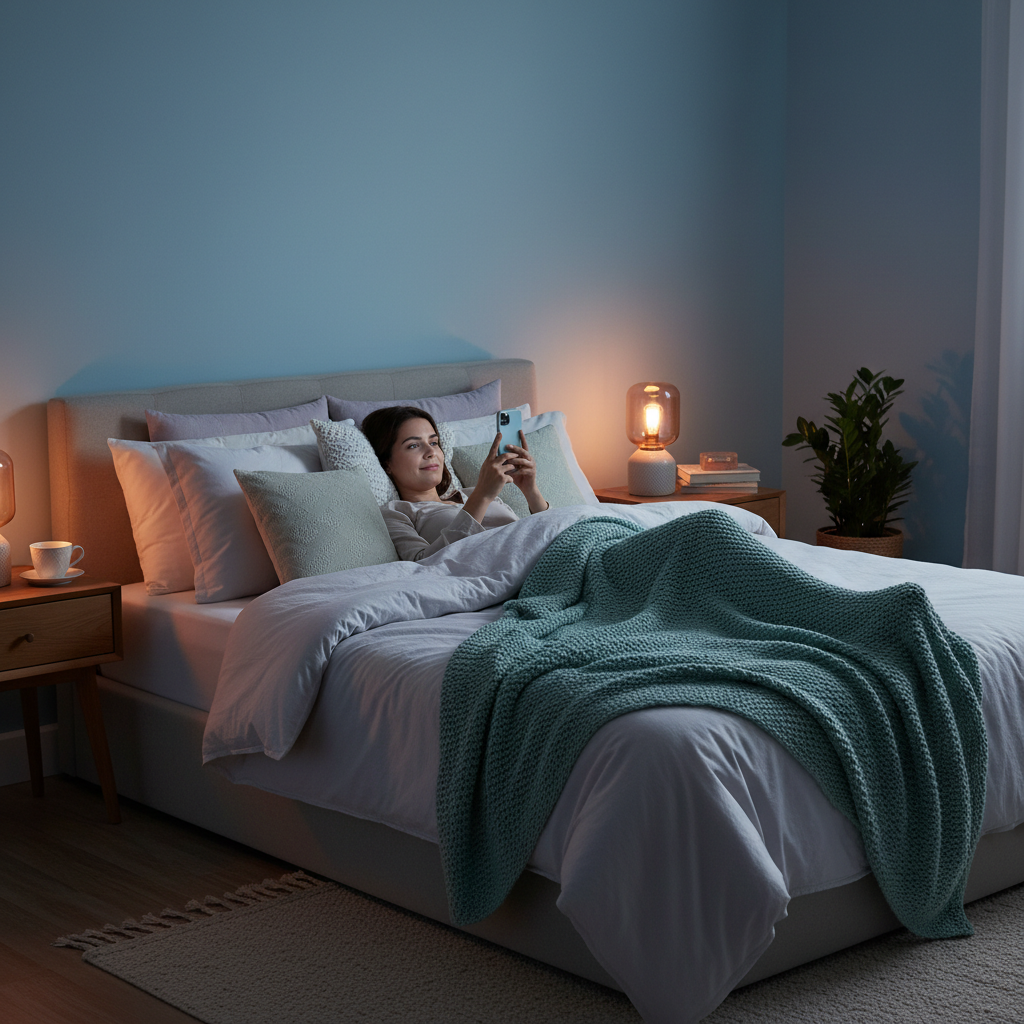
Screens off, lights low, and a consistent pre-sleep routine signal to your nervous system that competition mode is over. A five minute gratitude journal, four to seven to eight breathing, or even just 20 minutes of low stimulation reading can halve the time it takes to fall asleep. Keep the routine repeatable. Your brain learns the pattern and responds faster each night.
4. Time your last meal right 🍽️
The 3-2-1 framework is a practical baseline: finish dinner three hours before bed, stop alcohol two hours before bed, and switch screens off one hour before bed. Late, heavy meals elevate core body temperature and disrupt the early slow-wave stages. Alcohol may help you fall asleep but actively suppresses REM and increases sleep fragmentation in the second half of the night.
5. Use naps strategically 💤
The American Academy of Sleep Medicine recommends keeping daytime naps to 20 to 30 minutes, taken in the early afternoon. A well timed short nap improves alertness and sustains cognitive performance through the rest of the day without creating the grogginess (sleep inertia) that longer naps trigger. For athletes in heavy training blocks or those managing travel, a strategic 20 minute nap can be a legitimate performance tool.
6. Get morning light early ☀️
Natural light exposure within 30 to 60 minutes of waking anchors your circadian rhythm and sharpens the alerting signal that makes it easier to fall asleep that night. This is one of the lowest effort, highest impact habits in the toolkit. Walk outside for 10 minutes. No sunglasses needed.
Managing jet lag and travel 🌍
Travel is one of the most underestimated performance disruptors for competitive athletes. Crossing multiple time zones desynchronises your internal clock from local time, producing impaired sleep, slower reaction time, reduced motivation, and gastrointestinal disruption.
The CDC Yellow Book (Riedy and Williams, 2026 edition) outlines a clear framework for managing jet lag:
Before you fly: Shift your sleep time one hour per day toward the destination time zone in the two to three days before departure. Eastward travel is harder because it requires advancing your clock; westward travel tends to adapt faster at roughly 1.5 hours of adjustment per day compared to one hour per day for eastward.
During the flight: Time meals and light exposure based on the destination time zone. Stay hydrated and limit alcohol, which fragments sleep and worsens dehydration.
At the destination: Maximise outdoor light exposure during local daytime. Keep any daytime naps to 20 to 30 minutes only. For eastward travel, low dose melatonin (0.5 to 1mg) taken 90 minutes before local bedtime can support phase advance. Avoid high dose melatonin (above 5mg) as excess melatonin at the wrong circadian time worsens misalignment.
Reading your wearable data without obsessing over it 📲
If you are using an Oura ring, WHOOP strap, Garmin, or Apple Watch, you already have access to useful sleep data. But more data does not always mean better decisions.
The metrics worth tracking are:
- Total sleep duration: Are you consistently hitting seven to nine hours of time asleep (not just time in bed)?
- Sleep consistency: Are your bedtime and wake time within 30 minutes of each other across the week? Variability here, sometimes called social jet lag, disrupts your circadian rhythm even without international travel.
- Resting heart rate: Elevated RHR the morning after training or a poor night signals incomplete recovery.
- HRV trends: Day to day HRV fluctuation is normal. Focus on the seven day rolling average, not a single data point.
Use readiness scores as context, not commands. A low score on a day when you feel strong does not mean skip the session. A high score on a day you feel off does not mean push to maximum. The data informs; your body confirms.
Quick checklist: your minimum effective dose tonight ✅
You do not need to overhaul everything at once. Start with one change and repeat it for seven nights.
- 8 to 10 hours in bed ✅
- Caffeine cutoff 6 hours before bed ✅
- Room temperature around 18 degrees Celsius ✅
- Blackout curtains or sleep mask ✅
- Screens off 30 minutes before lights out ✅
- Consistent wake time, even on rest days ✅
Start tonight
Better sleep is the training you do without moving. Every repair cycle, every growth hormone pulse, every motor skill consolidated in REM sleep compounds over weeks and months into real, measurable performance.
You do not need a perfect environment. You do not need a complete routine overhaul. Pick the one habit from this guide that you are not currently doing and apply it tonight. Repeat it for seven days. Check your wearable, notice how training feels, and build from there.
The athletes who win over the long run are not always the ones who train hardest. They are the ones who recover best.
What is the one sleep habit you are implementing first? Drop it in the comments below. 💬👇🏻